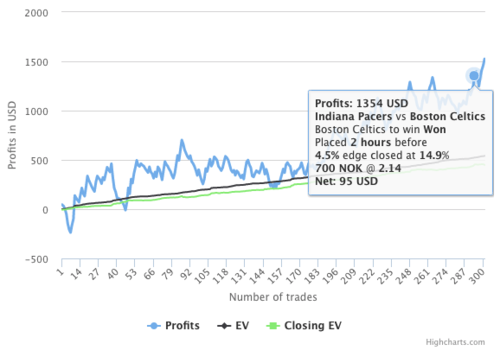
Closing line value (CLV) is whether the price you took beats the market’s closing price — the odds at kick-off (or event start) at a sharp reference.
Short-sample P/L is noisy. A correct +EV bet loses often; a −EV bet wins often. Over a large number of bets, bettors who consistently beat the vig-free close at sharp books are the ones whose process was actually priced ahead of the market. That is why CLV is the core edge check in sports trading — not whether yesterday’s ticket cashed.
Related maths: Expected value (EV), Value betting. Market efficiency context: Are sports betting markets efficient?.
What the closing line is
The closing line is the last tradable price before the event starts, shaped by all information and money that reached the market. At sharp, high-liquidity books it is the best single public estimate of fair odds available after the fact.
Analogy, not identity:
- Poker: review decisions by EV / pot odds, not by whether one hand won.
- Equities: compare to a benchmark (e.g. an index), not one day’s P/L.
- Sports: compare your taken price to the close.
You do not know the close when you place. You still track it afterward. Process quality shows up in the distribution of CLV across many bets.
How to measure CLV
Pick a sharp reference close (often Pinnacle or the sharpest book for that market) and the odds you actually got on.
Raw CLV (same selection)
raw CLV = (odds_taken / odds_close) − 1
- Positive → you took a longer price than the close (beat the close).
- Negative → you took a shorter price than the close (lost to the close).
- Zero → you matched the close.
Illustrative example (not a tip, not a live market): you take 2.45; sharp closes 2.28.
raw CLV = (2.45 / 2.28) − 1 ≈ 0.0746 = +7.46%
You beat the raw close by about 7.5% of the closing price. The bet can still lose on the result. CLV judges the price, not the settlement.
Vig-free CLV (fairer edge check)
Sharp closes still include overround (margin). Comparing to a raw close slightly understates how good your price was versus a fair two-way market. De-vig the closing market, then compare.
Two-way close (illustrative): Home 2.28, Away 1.72.
implied_home = 1 / 2.28 ≈ 0.4386
implied_away = 1 / 1.72 ≈ 0.5814
overround = 0.4386 + 0.5814 ≈ 1.020 (~2% margin)
fair_p_home = 0.4386 / 1.020 ≈ 0.4300
fair_odds_home = 1 / 0.4300 ≈ 2.326
You took 2.45 on home:
vig-free CLV = (2.45 / 2.326) − 1 ≈ 0.0535 = +5.35%
Same ticket: +7.46% vs raw close, +5.35% vs vig-free close. Report which definition you use and stick to it. For multi-way markets, de-vig across all outcomes the same way (normalise implied probabilities to 100%).
One-sided shortcuts like close × (1 + approx_margin) are rough; prefer a full-market de-vig when you have the other side(s).
Why beating the close predicts long-run profit
Over a small sample, variance dominates (law of large numbers). Over a large volume, only traders who repeatedly take prices longer than the sharp vig-free close tend to show lasting profit — because the close is the market’s final consensus.
Important distinctions:
- +EV at placement uses your
Pand the price you took (EV formula). - +CLV compares your price to the market’s final price.
- A bad model can invent “+EV” that never beats the close. Sustained +CLV is harder to fake.
- +CLV on one bet does not guarantee that bet wins. It means you were on the right side of the market’s final price.
Record placed odds, closing odds (and book), stake, and result. P/L alone does not tell you if the process is ahead of the market.
Soft books, sharp books, liquidity, and timing
Edges appear when books disagree. Soft books usually run lower payout (higher margin) and lower limits; sharp books usually run higher payout and higher limits, so more sharp money — and more information — clears there. Detail on how value shows up: Value bets: how value occurs.
Illustrative soft-vs-sharp path (numbers made up for the mechanism; not a tip):
- Sharp price on a home win sits near 2.68; a soft book is 2.50 (soft margin already baked in).
- Late information hits; sharp money hammers the home side; sharp close lands at 2.30.
- Soft book is slow or sticky at 2.50.
- Versus a ~2% sharp margin, a rough vig-free close ≈
2.30 × 1.02 = 2.346(prefer full two-way de-vig when you have it). - Soft ticket at 2.50 vs that vig-free close:
(2.50 / 2.346) − 1 ≈ +6.6%CLV if the soft price holds to off.
Mechanism, not a promise: for a soft edge to exist, the market often had to move a lot relative to soft margins. That same size of move is harder to fully reverse in the last hour than a 1–2% sharp-to-sharp discrepancy. Soft +CLV is still not free — limits, suspended lines, and stale screens are the cost (avoiding limits).
Time before kick-off
Odds reflect known information. The earlier you bet, the more time new information has to move the line for or against you. Trades closer to kick-off usually see smaller residual swings — and a higher chance that a true edge at placement is still an edge at the close. Early bets can still be +CLV; they need a wider buffer for move risk.
Liquidity
High-liquidity markets (major football leagues, big US leagues, top competitions) need more money to move. Low-liquidity leagues move on smaller tickets. A 5% “edge” four hours out in a thin league is far more likely to be gone (or larger) by the close than the same headline edge in a deep market. Lower liquidity ≠ automatic skip; it means higher close-volatility for the same placed edge.
Pinnacle often has the highest liquidity in many soccer/US markets and is a common closing reference — not the only valid one. Use the sharpest available book for that market.
False deviations happen: a sharp line spikes, then snaps back when the other side is taken. A ticket that looked +EV at placement can be −CLV two minutes later. As liquidity builds toward off, moving the line takes more money — another reason late, real edges are stickier than early noise.
CLV and bankroll
Beating the close does not remove variance. Stake size still decides ruin risk and growth — Bankroll management and Kelly. Oversizing a +CLV process still produces brutal drawdowns; undersizing just grows slowly.
Key takeaways
- Goal: take prices that beat the vig-free closing line of the sharpest relevant books — consistently, over volume.
- The close in high-liquidity markets is the market’s best fair-odds snapshot after the fact.
- Soft-book edges often require large market moves to appear; that can make them more likely to remain +CLV into off — with limit risk attached.
- Betting closer to kick-off usually reduces unexplained line swing.
- Low-liquidity markets are more volatile around the same placed edge.
When you want a workflow that surfaces prices against a reference line so you can judge edge before and after the close, start with Trademate Sports. No invented ROI — CLV is the audit; your staking rules do the rest.
FAQ
What is closing line value (CLV)?
A measure of whether your taken odds beat the market’s closing odds on the same selection. Common form: (odds_taken / odds_close) − 1. Positive CLV means you beat the close.
Is CLV the same as expected value (EV)?
No. EV uses your probability P and the price you took. CLV compares your price to the market close. Use both: EV for decisions at placement; CLV to audit whether those decisions were ahead of the market. See What is EV in betting?.
Should I use raw close or vig-free close?
Vig-free is the stricter edge check because it removes the sharp book’s margin. Raw CLV is fine for a consistent internal KPI if you always use the same reference book. Do not mix definitions when you compare periods.
Does beating the close guarantee profit?
No. CLV judges price quality. One +CLV bet can lose; one −CLV bet can win. Over a large sample, sustained positive CLV is what lines up with long-run profitability.
Which book’s close should I use?
The sharpest, most liquid book for that market (often Pinnacle in many soccer/US lines). Using a soft book’s close as your benchmark usually flatters you and weakens the audit.
Why do soft books limit +CLV bettors?
Sustained prices that beat the sharp close are a strong signal you are winning the pricing game. Soft books cut stakes or close accounts. That is a cost of the strategy, not proof CLV failed — how to avoid getting limited.