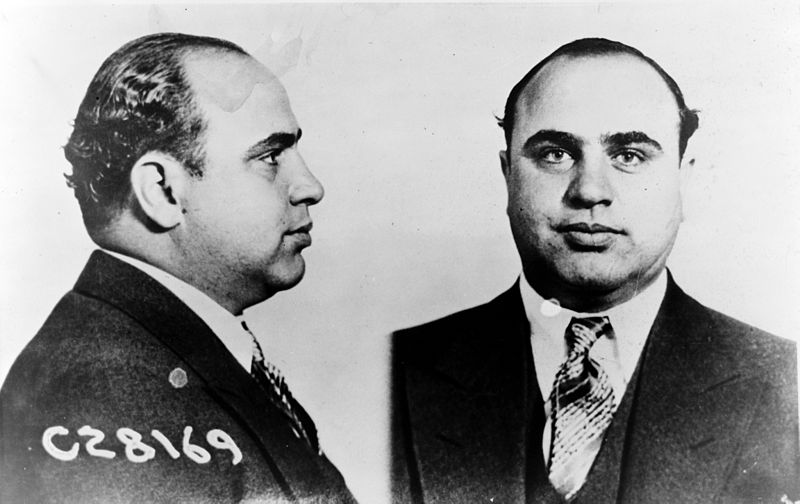
An interesting fact about dutching is that it was invented by Al Capone’s henchman, Dutch Schultz. Don’t let this frighten you though, as there’s nothing illegal about dutching when used for matched betting.
Top 3 Key Takeaways:
- Dutching is named after Al Capone’s henchman Dutch Schultz.
- Dutching equals arbing when done to ensure profits no matter the outcome.
- Dutching is a useful tool for keeping your matched betting accounts free of gubbing.
Dark History of Dutching
Arguably the most famous gangster in history, Al Capone made his fortune during the Prohibition Era in the United States. The dark times for the mob came with the legalization of alcohol, when the need for bootlegging ended. To stay rich, Al Capone and his gang had to come up with new ways of making money.
As these guys weren’t quite 9-to-5 office types, they decided to go with racketeering and bookmaking, the latter of which was Dutch Schultz’ job. Being a whizz for frauds, Dutch came up with all kinds of scams that would bring him and his boss millions.
Although most of those methods were (and still are) illegal, there was one that stood out from the crowd for being based on maths rather than intimidation.
In the honor of its creator, this method became known as dutching. In the years when Dutch Schultz was alive, the method was used for making sure profits by taking advantage of odds disparity in two or more different sportsbooks.
Basically, it was an old-fashioned version of arbitrage betting in which all the possible outcomes are covered and the winnings are the same regardless of what happens.
Is Dutching Still Profitable in 2020?
It’s been 85 years since Dutch Schultz was gunned down and his invention is still mostly alive in the betting universe, albeit not in its initial form.
Back in the day, it was possible to do dutching and make incredible profits, the reason being that the odds used to differ a lot from one bookmaker to another. Unfortunately today, bookies’ odds are pretty much the same, so arbing is no longer profitable.
As we have discussed in this blog article, dutching/arbing can bring you only small profits for only a certain period of time. After doing arbing for a few weeks, most arbers end up with suspended or, at least, limited accounts.
The reason for this is that arbs are often very easy to spot. It’s because the stakes you need to bet in order to ensure equal profits look very strange.
To show you what we’re talking about, it’s best to show an example. This time, it’s going to be the match between FC Volendam and De Graafschap, in which the odds on the home side are 2.50 at bet365.
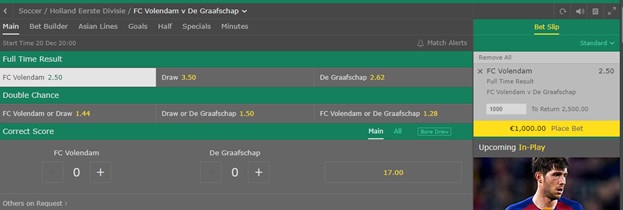
At the same time, the odds on X2 (double chance Draw/De Graafschap) are 1.70 at an Asian bookmaker such as Pinnacle. This means that bet is an arb, because if you bet the right stakes, you can ensure that you will get profits no matter the outcome.
By betting €404.76 on FC Volendam at 2.50 and €595.24 on X2 at Pinnacle, you’re going to get sure profits of €11.90. You will agree that stakes like €404.76 and €595.24 seem strange to put it mildly.
In this example, we focused on teams from the Dutch Eerste Divisie not because it reminds us of Mr. Schultz, but also to show you what kinds of events arbers bet on most of the time.
Considering the betting volume on major sporting events is huge, such as the English Premier League, the odds don’t change too often. But, in lower-tier events such as the one we used in the example, odds do go up/down from time to time, which is when you can catch an arb.
Unfortunately, most online sportsbooks don’t feel like letting the players bet large amounts of money on such events. Usually, the stakes are limited to a three-figure number.
But, even if you have the chance to stake several thousands of Euros, your profits wouldn’t be too big. As you can see in the example we used, to get a return of less than €12, you would need to bet a total of €1000.
This means that the percentage you earn is just over 1%. Most banks would offer you a much better deal than that.
Dutching With an Oddsmatcher / Calculator

Another big problem with arbing is that finding suitable bets by eye is not easy. That’s why players use oddsmatchers or arb scanners that browse selected bookmakers and surface candidate dutches. A calculator then sizes the stakes so returns are roughly equal across outcomes — or skewed if you choose.
Paid arb scanners exist; you can also dutch with a simple two-book oddsmatcher and a stake calculator. Exchange cover is often cleaner than two soft books — start with the ultimate guide if you need the matched-betting framing.
True equal-profit arbs don’t come up that often. When they do, size stakes carefully and act quickly before the odds move. You can also leave the stakes unbalanced on purpose if you think one outcome is more likely — just accept that the “sure” profit becomes a risked edge.
So, if you believe one outcome is much more likely to happen than the other one(s), you can adjust the stakes so that if the favorite wins, you will get a big profit, but if a surprise happens and the underdog wins, you will not lose anything.
Speaking of stakes, we do believe that it’s important to adjust them a bit from time to time. It’s because placing strange-looking stakes is a sure way of getting your account suspended. Our advice is to round them up, using round numbers, e.g. €50 stake instead of €48.67.
Using Dutching to Keep Your Accounts Safe
Doing dutching/arbing for making sure profits is guaranteed to get your account gubbed. If you have accounts to spare, feel free to do it, but we do feel the need to point out that you are not going to make big money.
If you’re a time traveler who could go back to the early 2000s, you would be able to make a fortune doing arbing. But, in 2020, that’s no longer the case. Nowadays, the best way to take money from bookmakers is to do matched betting.
How this betting method works is that you’re taking advantage of the bonuses that bookmakers give away. Matched betting helps you clear the bonuses, thus practically getting free money from them.
Obviously, no one likes giving away free money, bookmakers especially. This is why some of them hate matched bettors. But, they don’t need to know you’re doing matched betting.
The big question here is, how do I make bookmakers not realize I’m doing matched betting? This is where dutching steps in. This method can be your secret weapon in keeping your matched betting business hidden from the bookies eyes.
The thing is that you can fly under the radar only if you’re losing more money than you’re winning. If you’re taking a lot of money from bookmakers, you can be sure they are going to inspect your account more closely, which often ends in account restriction or suspension.
To prevent such a scenario from happening, you need to make yourself look like just another bettor, rather than revealing that you’re in fact a matched bettor.
In order to appear like a regular bettor, you need to lose some bets. Sure, losing bets means losing money, but thanks to dutching, you can make sure that the profit loss is minimal.
Let’s say your account at 888Sport is on the verge of getting gubbed. Famous for being very trigger-happy when it comes to account suspensions, 888Sport will gub you if they suspect that you’re doing matched betting.
To prevent this from happening, you need to lose some bets at 888Sport. But, you don’t want to lose too much money, which is why you should bet just the opposite at another sportsbook using the dutching principle.
For example, if you bet €100 on a major underdog such as SC Freiburg against Bayern Munich at 10.50 odds at 888Sport, you will have to lay that bet (bet that SC Freiburg will not win) at a betting exchange. Use a matched betting calculator to size the lay stake and liability.
Alternatively, you can cover with a double-chance X2 back at a sharp bookmaker. Look for the best available odds on that side — in this case, Draw/Bayern Munich around 1.05 at Pinnacle or a similar Asian bookmaker.
By betting €90 at 888Sport and €9 at Pinnacle, this would mean that no matter the outcome, your total loss would be €4.5. Not much of a cost for ensuring your account stays free from gubbing, don’t you agree?
Top 3 Key Takeaways:
- Dutching was invented by a mobster called Dutch Schultz.
- Dutching that brings sure profits is basically arbitrage betting.
- In 2020, the best way to use dutching is with matched betting.