Odds are the price of a bet. They tell you two things at once: how much you get paid if you win, and (as the inverse) what probability that price implies. Display format changes by region — decimal in most of Europe, fractional in the UK/Ireland, American (moneyline) in the US — but the underlying number is the same. Most books let you switch format in account settings.
This piece covers the three main formats, the odds ↔ probability conversion, and how bookmaker overround (margin) sits on top of fair prices.
3 things that matter
- Payout. Stake × decimal odds = total return (stake back + profit). You need the price before you can size anything.
- Implied probability.
p = 1 / decimal_odds. That is the book’s price expressed as a chance — not necessarily the true chance (see overround below). - Shop the number. A 0.01 move in decimal odds is a real edge difference over a large sample. Prefer the best available price on the selection you want.
What odds are (betting vs statistics)
In statistics, “odds” often means the ratio of probability of an event to probability against it. In gambling, odds are a payout multiple, and they do not have to equal the true probability of the outcome. Soft books set prices to attract liability and protect margin; sharp books set prices closer to a fair market and still take a cut.
Betting odds are set by the bookmaker (or by an exchange market). The most common football bet type is 1X2: home win, draw, or away win.
Implied probability from a price
Take a football match Manchester United vs West Ham. If Manchester United to win is priced at 2.00 decimal, the implied probability is:
1 / 2.00 = 0.50 → 50%
That is what the price says — not a claim that United truly win half the time. Once the book adds overround, the three 1X2 implied probabilities sum to more than 100%.
If West Ham to win is 3.00, implied is 1 / 3.00 ≈ 33.3%. The remaining share of the market (draw, and any overround) sits in the other prices.
Payout language: at decimal 3.00, a €1 stake returns €3.00 total if it wins (€2.00 profit + €1.00 stake). Fractional “3/1” is the same idea stated as profit:stake.
Formula: odds ↔ probability
decimal_odds = 1 / probability
probability  = 1 / decimal_odds
Example: a team with a true 50% chance of winning has a fair decimal price of 1 / 0.50 = 2.00. The other way: 1 / 2.00 = 0.50 (50%). Probabilities here are on the 0–1 scale (0.30 = 30%).
Odds are the inverse of probability and vice versa. That conversion is exact for a single outcome’s price; it does not by itself tell you whether the price is +EV.
How bookmakers set prices (overround)
The odds on a book’s site are usually worse than fair. The book builds in a margin — often called overround or vig — so that if you sum the implied probabilities of all mutually exclusive outcomes in a market, you get more than 100%.
On a 1X2 market the three true probabilities sum to 100%. After the book adds margin, the three implied probabilities from the posted odds sum to more than 100%.
If the book takes a 5% margin in the usual overround sense, the sum of implied probabilities is about 105%, not 100%. A 10% margin → about 110%.
Short version: posted prices are shorter than fair. The house edge is in the overround.
Worked overround example (illustrative)
Spain vs Italy, friendly, 1X2. Suppose a fair assessment is:
| Outcome | Fair probability |
|---|---|
| Spain | 60.6% |
| Draw | 22.2% |
| Italy | 17.2% |
| Sum | 100% |
The book then posts shorter prices so the implied probabilities sum to more than 100%. Books also shade individual outcomes for liability; the table below is a stripped illustration, not a live market.
Illustrative offered prices:
| Outcome | Offered odds | Implied probability (1/odds) |
|---|---|---|
| Spain | 1.54 | 64.9% |
| Draw | 4.22 | 23.7% |
| Italy | 5.40 | 18.5% |
| Sum | ≈107.1% |
So overround ≈ 7.1% on this board (107.1% − 100%). Two-decimal odds rarely land on a round overround; that is normal.
Long-run, that overround is the book’s edge if the fair probs were right and the public takes the posted prices. You beat it by getting better than fair prices (value), by clearing promo EV (matched betting), or both — not by hoping the house is generous. For +EV pricing tools: Trademate Sports.
On major leagues, soft books often sit around ~5% overround on main 1X2 (sum ≈ 105%); smaller leagues are often 10%+ (sum ≈ 110%+). If your main book is consistently wider than that on liquid markets, shop elsewhere.
The three main formats
Decimal (European), fractional (British), American / moneyline (US). Same price, different notation.
Decimal odds
Most used worldwide outside the UK and US. Decimal odds are the total return multiple including stake:
profit = (decimal_odds × stake) − stake
return = decimal_odds × stake
Illustrative 1X2 prices (not a live market, not a season claim):
| Outcome | Decimal | Implied |
|---|---|---|
| Favourite | 1.40 | 71.4% |
| Draw | 5.00 | 20.0% |
| Underdog | 7.75 | 12.9% |
Stake €100 on the favourite at 1.40:
- Return:
1.40 × 100 = €140 - Profit:
140 − 100 = €40
Stake €10 on the draw at 5.00:
- Return:
5.00 × 10 = €50 - Profit:
50 − 10 = €40(not €50 — €50 is the return, which still includes your stake)
Stake €10 on the underdog at 7.75:
- Return:
7.75 × 10 = €77.50 - Profit:
77.50 − 10 = €67.50
More detail and conversions: Decimal odds explained.
Fractional odds
Also called British odds. Written as profit / stake (numerator / denominator). At 10/1, €1 stake wins €10 profit plus stake back (€11 return). At 5/2, €2 stake wins €5 profit.
UK horse racing popularised the format long before modern football markets. Many UK books still default to fractions; the same selection in decimal is usually cleaner for conversion and for comparing prices across books.
More detail: Fractional odds explained.
American (moneyline) odds
US default. Anchored around a $100 reference:
- +200 — risk $100 to win $200 profit (underdog / plus money)
- −200 — risk $200 to win $100 profit (favourite / minus money)
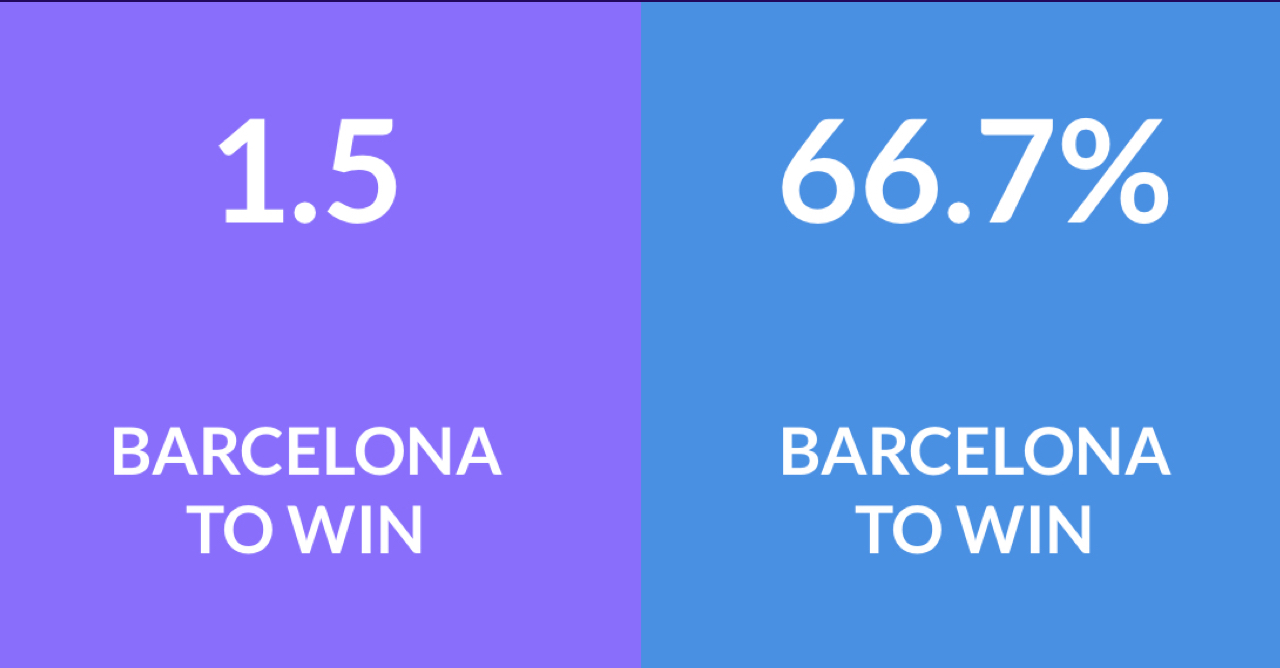
Same prices in decimal: +200 → 3.00, −200 → 1.50. Related market article: What is the moneyline?.
Practical takeaways
- Learn all three formats so a US or UK screen does not slow you down; work in decimal when you can — conversion to implied probability is
1/odds, and comparing books is easier. - Most books let you switch display format in settings. Online conversion tables are fine for one-offs; do not size bets off a misread fraction.
- Fractional boards are often quoted on coarse ticks, which can round you off a better decimal equivalent. American is usually a clean transform of the same underlying price. Either way: compare the decimal (or the implied %) before you click.
- Always separate return from profit. Return includes stake; profit does not. Mixing them up is how soft articles invent fake payouts.